Body Recomposition Calculator
Free body recomposition calculator for losing fat and building muscle at the same time. Enter your stats and get calories, protein, macros and a realistic week-by-week timeline.
April 17, 2028
140 lb · 73 weeks · −60 lb total
Your Recomp Plan at a Glance
| Emphasis | Calorie target | Protein | Training signal | Best for |
|---|---|---|---|---|
| Balanced recomposition | About 5% below TDEE | 1.6–2.2 g/kg bodyweight | 3–5 progressive lifting days per week | Most lifters starting recomp |
| Fat-loss-led recomposition | About 10% below TDEE | High enough to protect lean mass | Keep strength stable while waist drops | Lifters with 15%+ body fat to lose |
| Muscle-gain-led recomposition | At maintenance | High, with room for carbs | Add reps or load over time | Leaner lifters or performance-first |
| Very lean lifters | Maintenance or small surplus | High and consistent | Prioritise recovery and strength | Men below 12% BF, women below 18% |
| Advanced lifters | Maintenance, small adjustments | Consistent and adequate | Progress measured over months | Near natural ceiling |
For your personalised numbers, use the calculator above.
How Body Recomposition Works
Body recomposition, often shortened to recomp, is the process of losing body fat and gaining or preserving muscle at the same time. Instead of alternating between a bulking phase (surplus, more muscle plus some fat) and a cutting phase (deficit, less fat plus some muscle loss), recomp aims for both outcomes in the same block of training. The result is typically a stable or slowly-falling scale weight while body composition improves visibly.
Dual goals: fat loss and muscle gain at the same time
Recomposition sets two goals the body usually trades off against each other. Losing fat normally requires a calorie deficit; building muscle normally requires enough energy to support growth. The two co-exist here because training provides a strong enough muscle-building signal to offset a small deficit, and the body can draw the rest of the energy from stored fat.
Calorie balance: maintenance or a small deficit
For recomposition, calorie intake usually sits at maintenance or with a small deficit of around 5% to 10% below TDEE. Deeper deficits speed up fat loss but suppress muscle gain and recovery. Surpluses add fat without a proportional muscle benefit. The small-deficit sweet spot is the whole point of recomp.
High protein: the non-negotiable
Protein is the most important variable for successful recomposition. Protein targets of 1.6 to 2.4 grams per kilogram of bodyweight, roughly 0.8 to 1.1 grams per pound, support muscle protein synthesis, protect lean tissue in a deficit, and improve satiety. The Morton et al. 2018 meta-analysis in the British Journal of Sports Medicine identified 1.6 g/kg as the functional ceiling for strictly maximising lean-mass gains, with 2.2 g/kg as the upper confidence bound.
Resistance training: the signal to build
Hard, progressive resistance training gives muscle tissue the signal to grow while the body uses stored fat for energy. Train each muscle group twice a week where practical, aim for 10 to 20 hard sets per muscle group per week, and add weight, reps or better execution over time. Cardio is optional support, not the muscle-building signal.
Who Body Recomposition Works Best For
Recomposition works for most lifters, but not equally well for everyone. The rate and degree of success varies significantly based on four factors: training status, body fat percentage, age, and current muscularity.
Beginners (under 1 year of consistent training)
Beginners get the fastest recomp results. Untrained muscle tissue responds strongly to new stimuli, the period commonly called "newbie gains." Lifters with less than 1 year of consistent training can add muscle while eating below maintenance, a window that closes gradually as training age increases.
Returning lifters (muscle memory effect)
Anyone returning to training after a long break sees fast early recomposition thanks to the muscle memory effect, the retained neural and cellular signatures of previously trained tissue that let it rebuild faster than it was originally built.
Lifters with higher body fat
Higher body fat gives recomp a metabolic advantage. The body has substantial energy reserves to cover a calorie deficit, which leaves more room to build muscle while eating below maintenance. Men with 15%+ body fat and women with 25%+ body fat are strong recomp candidates.
Women
Women can use the same approach with the same principles: small deficit or maintenance, high protein, progressive resistance training, and enough recovery. The calculator uses the female Mifflin-St Jeor coefficient and female body-fat thresholds automatically. Because menstrual cycle changes can mask weight, water retention and performance from week to week, women should rely more on multi-week trends, waist measurement and progress photos than on daily weigh-ins.
Skinny-fat lifters
Skinny-fat describes a body that looks normal-weight but holds a disproportionate amount of fat, typically 20 to 30% body fat in men or 30 to 40% in women at an otherwise average weight. Skinny-fat lifters are one of the best recomp candidates. Bulking adds visible fat quickly, cutting leaves a smaller softer version of the same shape, and recomposition with high protein and progressive resistance training is usually the fastest route to a visibly leaner, more muscular body.
How to Measure Recomp Progress When the Scale Does Not Move
Body recomposition breaks the scale as a measurement tool. Fat lost and muscle gained push body weight in opposite directions. If you lose 2 kg of fat and gain 1 kg of lean mass, the scale shows 1 kg down. If your glycogen stores refill from better training, the scale may show nothing, or go up, even while you are visibly leaner. That does not mean nothing is happening. It means scale weight is a blunt tool for a body-composition goal.
Three measurements give you a far more accurate picture of recomposition progress.
Weekly progress photos
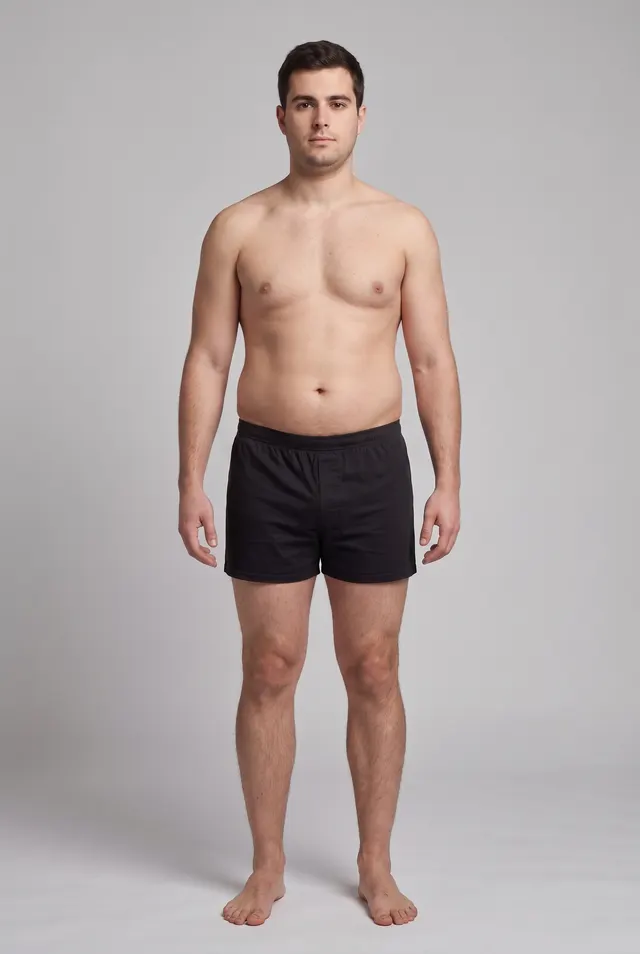
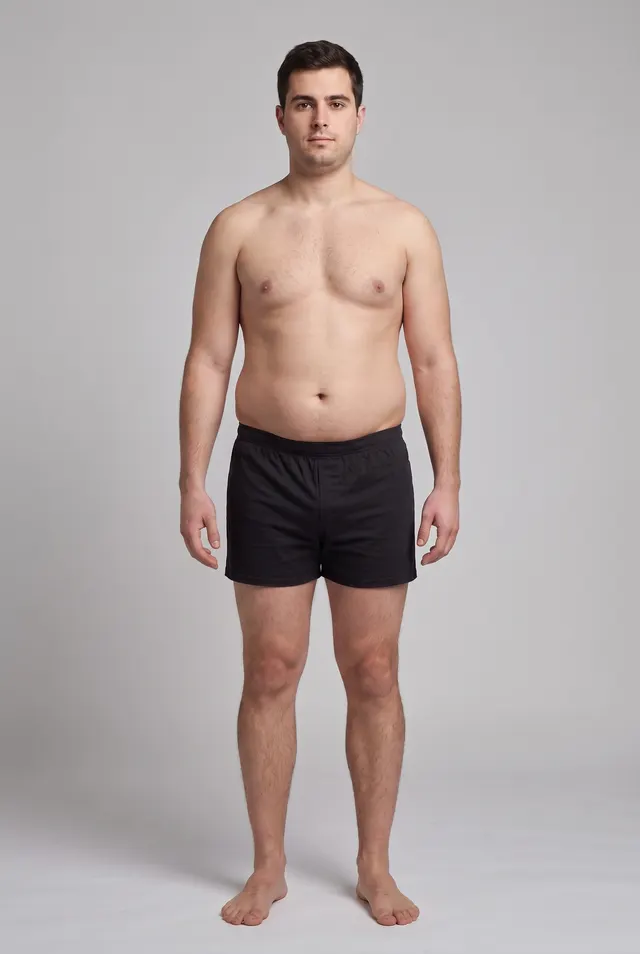
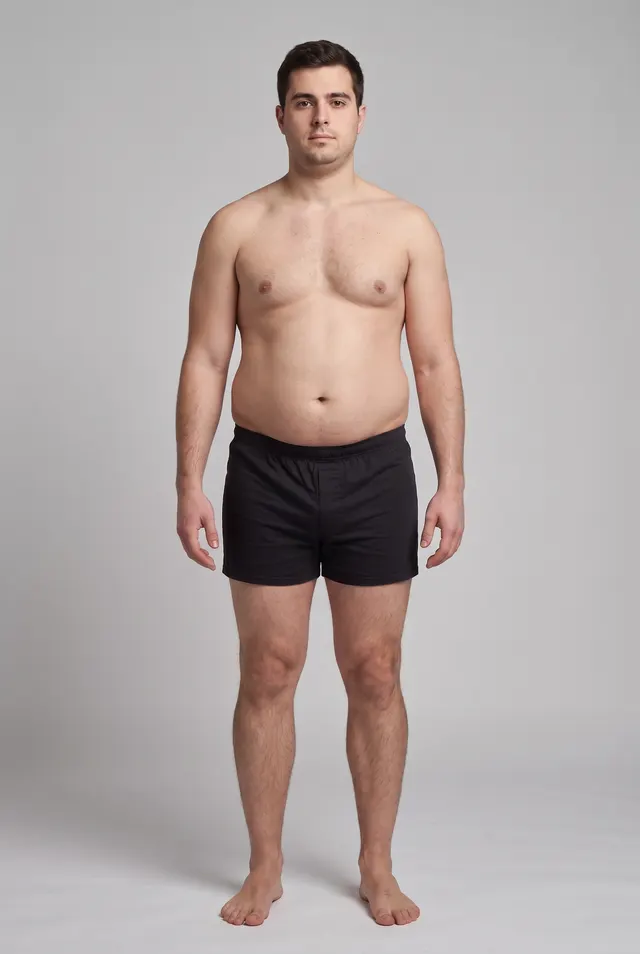
The single most reliable measure of body recomposition is weekly progress photos taken from the same angle, distance and lighting. The visual change from a 1 kg shift between fat and muscle is dramatic, and completely invisible on the scale. If weekly photos feel too frequent, monthly works too, but the same conditions matter more than frequency. Our free Progress Photo Comparison tool lets you align and compare two photos side by side. The Body Tracker app does this automatically on a timeline, with before-and-after sliders and time-lapse export.
Waist circumference
Waist circumference, measured first thing in the morning at the narrowest point of the abdomen, is the most responsive single-number indicator of fat loss during recomp. A tape measure costs nothing. Record the number weekly. A falling waist with a stable scale is recomposition working exactly as intended.
Strength progression
Recomposition requires a training signal. If you are not tracking lifts, you are guessing whether the signal exists. Strength does not need to climb every single session, but over a useful block (6 to 8 weeks) you should see some combination of more reps, more load, better control or better consistency. If every meaningful lift is sliding backward for weeks, the deficit is too aggressive, recovery is poor, or the program is not giving the target muscles enough useful stimulus.
Why the scale is the worst measure of recomposition
The scale can swing 1 to 2 kg in a day from water, sodium, glycogen, digestion, menstrual cycle, sleep or soreness. A real recomp signal over 8 weeks might be 2 kg of fat loss and 1 kg of muscle gain, a net 1 kg drop that hides inside 2 kg of daily noise. Looking at weekly average weight helps, but photos, waist and strength tell you what the scale cannot: whether your body composition is actually changing. Our guide to progress photos vs the scale walks through the same idea with real before-and-after examples.
How Long Does Body Recomposition Take?
The week-by-week projection chart in the calculator above shows projected body composition over 12 weeks given your inputs. It is there because recomp is slow enough that an honest timeline matters more than a single number.
In general, visible recomposition results typically take 8 to 16 weeks, and meaningful visual change takes 3 to 6 months. Beginners and returning lifters may see faster changes; advanced lifters should expect slower progress and smaller visual changes. The calculator shows a 12-week projection because that is long enough to collect a real signal without pretending recomp is instant.
The projection uses conservative muscle-gain rates based on Lyle McDonald's model for natural muscle-building limits, adjusted for training age and (for lifters over 50) age. Fat loss is capped at 0.5% of bodyweight per week to stay inside safe and realistic ranges.
The Formulas Behind the Numbers
No black box. Every number this tool shows comes from published equations and one honest simplification per step.
Resting metabolic rate
If you provide body fat, resting metabolic rate is estimated by averaging two established equations: Mifflin-St Jeor (1990) uses sex, age, height and weight, and Katch-McArdle uses lean body mass (bodyweight minus fat) with RMR = 370 + 21.6 × lean mass (kg). When body fat is not provided, Mifflin-St Jeor is used alone.
Total daily energy expenditure
Resting metabolic rate is multiplied by an activity factor based on your workday and weekly training volume. The activity choice already includes lifting; the calculator does not ask for extra workout calories.
Calorie targets by emphasis
Balanced recomposition applies a 5% weekly deficit from TDEE. Fat-loss-led recomposition applies a 10% weekly deficit. Muscle-gain-led recomposition sits at maintenance (0% deficit). Training and rest cycling is optional; it moves calories and carbs toward lifting days while preserving the weekly average.
Protein targets
Protein is set from lean mass when body fat is available (2.3 to 2.8 g/kg lean mass depending on emphasis), with a bodyweight floor and cap (roughly 1.6 to 2.4 g/kg bodyweight). These ranges sit inside the Morton et al. (2018) meta-analysis (about 1.6 g/kg as the functional ceiling for fat-free mass gains), the International Society of Sports Nutrition position stand (1.4 to 2.0 g/kg) and Helms et al. (2014) for lean dieters in caloric restriction (up to 2.3 to 3.1 g/kg lean mass).
Fat and carbs
Fat has a floor of max(0.6 g/kg bodyweight, 20% of calories). Carbs receive the remaining calories after protein and fat; not a moral choice, just arithmetic.
Muscle-gain rates by training experience
The 12-week projection uses conservative monthly muscle-gain rates from Lyle McDonald's model, scaled for age over 50 following the Peterson et al. (2011) meta-analysis of resistance training in older adults.
Common Body Recomposition Mistakes
Treating recomp like a crash cut
A hard deficit (more than 20% below TDEE) can produce faster scale loss but it is rarely a clean recomposition setup. The leaner and more trained you are, the more a hard deficit pushes against performance and muscle gain. If fat loss is the only goal, use a cut. If recomp is the goal, keep the deficit small enough that training still has a chance to progress.
Overestimating daily activity
Most TDEE calculators are easy to break because people pick the activity level they wish described them. Lifting four times a week does not automatically make someone "very active" if the rest of the day is a desk, a car and a couch. Choose the honest option. Adjust from real trend data after 2 to 4 weeks.
Changing the plan every week
Recomposition is slow and noisy. Water, glycogen, sodium, digestion, soreness and cycle changes can all hide progress on the scale. Changing calories every few days guarantees you never learn whether the target worked. Run the plan for 2 to 4 weeks before changing anything.
Letting cardio replace lifting
Cardio is good for the heart. It is not the signal for muscle preservation or gain. During a recomp phase, cap steady-state cardio at 2 to 3 sessions per week and never at the expense of a lifting session.
Only tracking the scale
Recomp requires multiple signals. Weekly average weight, waist, progress photos and training performance tell the story together. The scale alone will mislead you at least once a week.
Frequently Asked Questions
Yes, but it is slower than doing each phase separately and works best under specific conditions. Body recomposition is most effective for beginners new to resistance training, people returning to training after a break, lifters with higher body fat (15 to 30 percent in men, 25 to 35 percent in women), and anyone who has not trained consistently with progressive overload. A 2020 review by Barakat and colleagues in the Strength and Conditioning Journal confirmed that even trained lifters can recomp, though progress is slower.
More Body Tracker Tools


Related Reading

References
A short list of the sources behind every number this tool produces.
- Barakat C., Pearson J., Escalante G., Campbell B., De Souza E.O. (2020). Body recomposition: can trained individuals build muscle and lose fat at the same time? Strength and Conditioning Journal 42(5), 7–21. Full text.
- Morton R.W., Murphy K.T., McKellar S.R., et al. (2018). A systematic review, meta-analysis and meta-regression of the effect of protein supplementation on resistance training-induced gains in muscle mass and strength in healthy adults. British Journal of Sports Medicine 52(6), 376–384. Full text.
- Helms E.R., Zinn C., Rowlands D.S., Brown S.R. (2014). A systematic review of dietary protein during caloric restriction in resistance trained lean athletes: a case for higher intakes. International Journal of Sport Nutrition and Exercise Metabolism 24, 127–138.
- Mifflin M.D., St Jeor S.T., Hill L.A., Scott B.J., Daugherty S.A., Koh Y.O. (1990). A new predictive equation for resting energy expenditure in healthy individuals. American Journal of Clinical Nutrition 51(2), 241–247.
- Peterson M.D., Sen A., Gordon P.M. (2011). Influence of resistance exercise on lean body mass in aging adults: a meta-analysis. Medicine and Science in Sports and Exercise 43(2), 249–258.